Tuesday, 15 March 2016

Where to ski: Châtel, Haute Savoie, France

Wondering where to go skiing? You could do worse than my favourite French Alp destination, Châtel. I almost hate sharing this tip, because it's not overrun and I'd hate to see it get crowded. On the other hand, it's so great it deserves a bit of a plug.
For a start, it's an actual town, as opposed to a resort, so it has all the things a real place should, like boulangeries, a marie, a primary school, a weekly market (Wednesday mornings), a little supermarket, laundromat, post office, pharmacy and two cinemas, as well as, of course, bars, restaurants and plenty of gift shops. It's the sort of place where you keep bumping into the same school group or recognise the chap who fit your skis when he's coming back with his baguette. And? He'll recognise you too. 

It's part of the massive Portes du Soleil ski region, which encompasses 12 resorts, some in France, some in Switzerland. The idea is that you could, in theory, ski from one to the next, taking in hundreds of kilometres of pistes (and off-pistes) of skiing. In truth though, having skied from Avoriaz to Châtel last winter, it's actually more exciting to ski from one country to another (which can also be done from here). Most of the domains offers plenty enough skiing to see you through a week, so it's not necessary to buy that all areas pass – unless you're hell bent on racking up the klicks...

One of the things I like about this place is the old chalets, none of which seem completely abandoned and some of which seem to have been half done up – literally half. Like someone's cut it in two and fixed up one side only.

But to the skiing... It's spread out along a valley, with plenty of buses (free to lift-pass holders, though no one ever checks so you could in theory get on without a lift pass too) to take you from one feeder lift or gondola to another, starting with Abondance at one end, through Petite Châtel, Châtel, Linga and then Pre-La-Joux at the end. You could also ski from one to the next, if ability is no object (don't try it if you get nervous on anything trickier than a blue though) and they get busier as you go along, so Petite Châtel, for instance, is where you'll find yourself alone on a run and Pre-La-Joux can look a bit like an anthill when it's at full throttle. No. That's an exaggeration, but it's is definitely the busiest end. Which we couldn't quite get, because Châtel, to our minds, was the nicest area.

We stayed at Hotel L'Edelweiss, a one-star chalet-style hotel about a five-minute walk from the bus stop, 10 to the Super Chatel gondola, depending on how fast you can walk in ski boots carrying skis (or a board, of course). It is an uphill walk, but the plus side is it's downhill at the end of the day. Also, if you hire your equipment from the very nice people at Vincent Sport (where, helpfully, they speak English), you can leave it all there and pick up and drop off en route every day. And Vincent Sport is literally across the street from the bus stop and five minutes' walk from that gondola.

Dinner at L'Edelweiss is good: €16 gets you the set, three-course menu, which features local specialities, like tartiflett, raclette and the local lake fish. They will also accommodate a vegetarian, and were happy to make me an omelette or pasta. Our room was basic, but perfectly comfortable and clean, wifi was fast and there was even a TV, though we never got round to turning it on.

There aren't many black runs, but plenty of reds and blues. For the wide, gentle runs, head to the back of the mountain looking toward Switzerland. Having said this, the better skier of the two of us found plenty to keep him occupied during a week and often had the steeper pistes to himself.

I have to admit though, I've reached the point where it's not long before I'm already ready to throw myself into one of those sloping rockers and catch a few rays, and lunch always tastes better eaten at a piste-side restaurant surrounded by those beautiful mountains.




Saturday, 20 February 2016

Avignon, southern France

I had exactly 1 hour and 40 minutes to visit Avignon. It was a bit like being Cinderella, as I was tied to the A15 bus schedule and needed to be back in time for the dogs' afternoon meal and walk... So, I planned my trip to the minute.

Fortified 13th-century walls are kind of what it's all about here. Oh, and some bridge... 

The walls are pretty cool and astonishingly intact but, once you're inside them, there's some pretty amazing modern architecture. I spotted an art deco cinema on a side street and had to go take a closer look, being that it's one of my favourite styles. It's the fonts really, that do it for me. 
And then, back on the main drag – Cours Jean Jaurés – there was this amazing art nouveau building, just sitting there like it was no big deal. I was aiming for the bridge though: real name Pont St-Bénézet. I wasn't going to have time to make a visit to the Palais des Papes worthwhile, but it looks impressive and there's a crazy building opposite. That is, everything about it is just ridiculously enormous: the decorations, the scale of the façade and the way there aren't any windows above street level. I wish I could tell you what it was (if you know, please tell me!), but I pretty much just scuttled past, following the signs for Pont St B. I'd used up some of my precious alloted time by shopping. I know! Quelle horreur! But there are a lot of shops lining that Cours Jean Jaurés. Just warning you, is all.

There's a €5 admission to get into the bridge bit, but once you've paid full price to get into one of the historic landmarks in this town – and there are several, including the Palais and a number of museums – you get a stamp on your admission ticket and this gives you a discount to all the others if you visit the same day. The entry fee also gives you a hand-held audio guide, which was useful. 

Obviously, once upon a time the bridge went right across the Rhône and over the two islands in the water here, but seiges and floods have taken their toll and now there's just this spur. It has a sweet little chapel on it, where a plaque announces it's been the site of 'many miracles'. 

There are various extras in the gatehouse: a downstairs exhibition and cine area, for instance. I recommend you go with a more generous time allocation, because it was about this point that I realised I'd need to hoof it back pronto to get that bus... 

Just a tip: the bus lets you off on the road opposite the entrance to Avignon. But to get the bus back, you need to go inside an implausible-looking building to the left of the Gare Routière, where, voilà!, all the different bus lines park up.


Tuesday, 16 February 2016

The Duke's place, Uzès, France

You can go to the website to read all about the Duchy of Uzès, so I won't go into all the history of it. What I will say if you go on the guided tour (€18) – which I'd recommend, because it gets you inside some of the rooms – and you're not a French speaker, is that you'll be given a ringbinder notebook that tells you about what you're looking at. However, as a keen student of the language, I listened very hard to our guide and managed to pick up a few bits that weren't written down. For instance, 'fantôme'. I didn't need to be a French scholar to know what that meant! Apparently, this place is very definitely haunted. However, absolutely nothing happened while I visited to say this was so.

My favourite bits? The portrait of Peggy Bedford, American grandmother of the current 17th Duke of Uzès (we Americans do like to get around! She appeared to be quite glamorous and pretty, too, not a million miles away in looks from Grace Kelly and, similarly, died in a car accident...), and the view from the top. Ooh, la la! Très beau!

Another nice thing is the wabi-sabi building opposite the entrance to the Duke's palace, with the words 'Telephone Uzès' painted on the front between the first and second stories. Aside from the 21st-century cars parked outside, you could be standing here a hundred years ago.

Actually, that's a lot of the charm of Uzès: that the old is allowed to be and hasn't been modernised beyond recognition.

I've been sitting here, writing this and enjoying some of the local wine while I do (it never hurts to house-sit for a wine importer...) and thinking that, if you'd asked my 16-year-old self, "Where do you think you'll be in 40 years?", I would never ever have come up with this scenario...


Monday, 15 February 2016

Nîmes, France

Checked the bus timetable twice yesterday. OK, maybe three times. It's not straightforward if you're not used to all the codes and, also, it's all in French, but still basically totally usable. So, 8.45am saw me waiting in the blustery Esplanade watching the school kids get off their buses and slouch off. And then – hurrah! My B21 bus hoves into view. "Un pour Nîmes, si vous plait."

"Non, jfljasfj f ljskflj s pas."

"Pardon? Répéter, si vous plait?"

"Pas de Nîmes sfl;jsfls sklfj;jfopzx ox xjl direction."

"Ah, d'accord. Merci."

No, I don't know what he said really, but it seemed to be, as best I could guess, that he was coming from Nîmes, not going toward it. Or something. All those French classes and get me out with real people speaking real French and – boom. Rien. Is alright, because a few minutes later, here comes the E52 bus - phew!

"Bonjour. Un pour Nîmes."

"Vous allez Nîmes? Clasdfljflnf pas sllsjf s x sdlsljfos direct."

Oh, dear. Think hard. "Ici?"

"Oui. Dix minutes."

"Merci."

Better this time. I actually got that he was telling me there was a direct express bus in 10 minutes.

Third time lucky. And, like in Spain, the public buses here are very nice: clean, comfy, heated... So pleasant to look out the window at the beautiful scenery. And then, after a mere 40 minutes from Uzès, where I got on, we pull up behind the Gare Routière (train station) and I actually manage to ask the bus driver what time the return bus goes. Even he has to look it up. Eh, bien. But just as well I asked, because it's a half hour different from what I'd written down the day before...

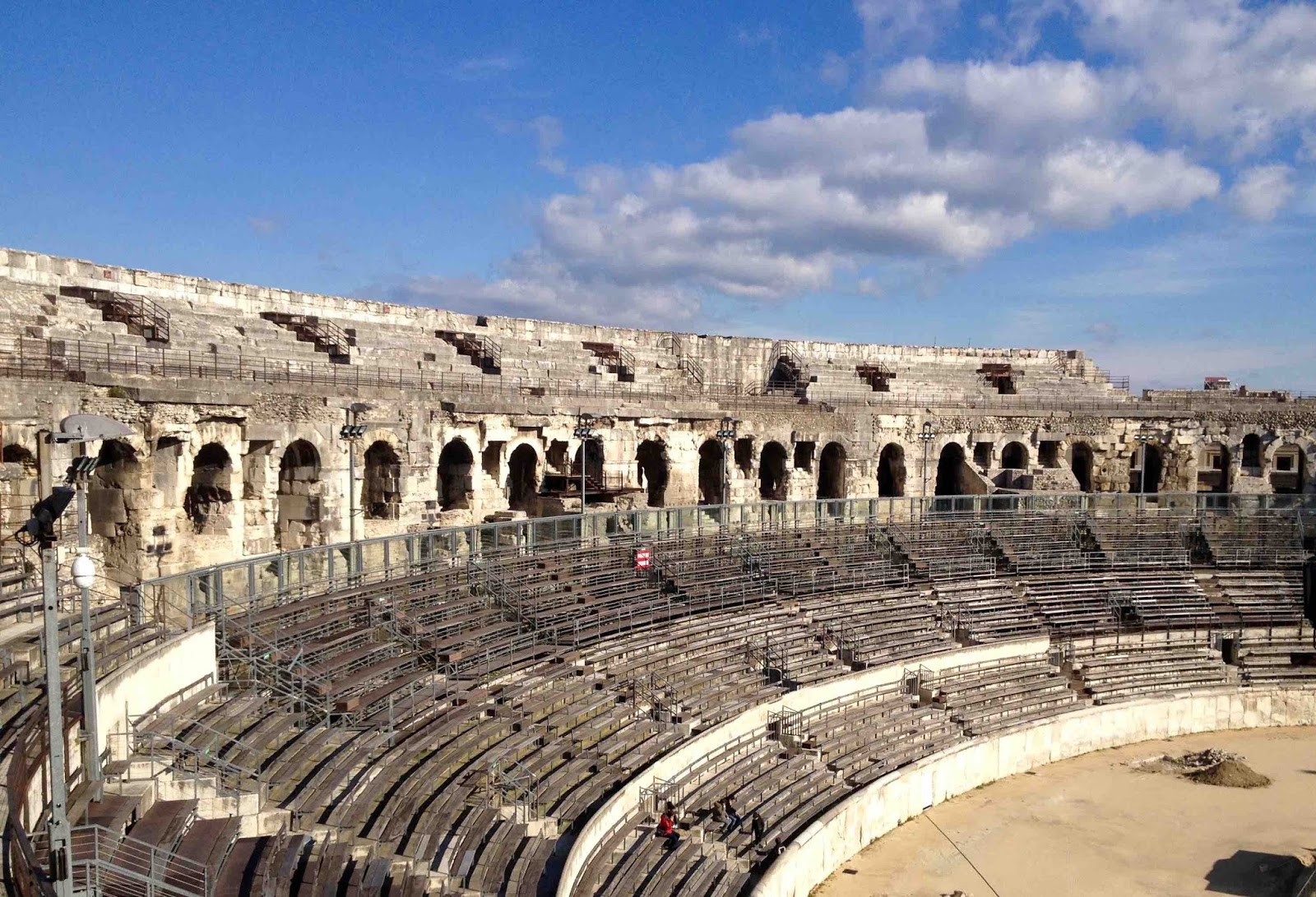
But enough about buses. I'm here to see the sites and, with just three hours (I must be back in time for the dogs' dinner and walk – I'm pet-sitting, you remember), I have it all figured out. First stop, the Roman Arena – or ampitheatre: the best preserved of its kind. And it's stunning.

Nîmes was the most important Gallo Roman town in the region – known as the Rome of France – and had a fortified wall all around it and a population of over 50,000. I plump for the 3-in-1 ticket, which gives you entry to the Arena; the Maison Carrée (which means 'square house', but in ancient Rome, a square was anything with right angled corners, so rectangular Maison Carrée sneaks in), the best preserved ancient Roman temple anywhere; and the Tour Magne, which is on Nîmes's highest point and all that's left of the old fortifications. The ticket is €12 for all three and includes an audioguide at the Arena, a film at the Maison Carrée (there's actually nothing else inside but the cinema) and entry to the Tour and is a bargain even if you only get to two of them, like I did.

As well as a good commentary, so I came away actually having learned something about gladiators and the whole business around them – for instance, they weren't slaves who had to fight to the death, but more like today's boxers, who gave themselves over to learning to fight and living the life to get fame and fortune, and didn't usually fight to the death – there's also two very small exhibit rooms: one about gladiators, with replica weapons and armour and clips from Hollywood films depicting them; and one on bullfighting, which was, to my mind, the more interesting, especially when it came to the horses the matadors ride in the ring with the bulls. This is top-level dressage in action.

Although Lonely Planet says not to bother with the film shown in the Maison Carrée, I disagree. It tells a compelling, watchable story, the computer graphics showing how the Gallo Romans built the town are impressive and I wasn't bored for a minute. Also, helpfully, there are English subtitles.

Staying in Uzès, which is hard by the Vallée de l'Eure, where the source of the water that travelled 50km by Roman-built aqueduct to Nîmes is – and which I've been to see at its source – makes it even more special watching it arrive, very prettily, in the Quais de la Fontaine. The fountain (way down at the end of my picture, but not really visible here – sorry!) marks the entrance to the Jardin de la Fontaine, which was one of the first public parks in Europe and features a beautiful statue of a water nymph, a Roman temple dedicated to Diana and the entrance to the green bit of the park where the Tour Magne is.

Unfortunately, this was where my time ran out, so I made my way back to the Gare Routière, bought a slice of French pizza – the only food in all of France that leaves a tinge of disappointment – and waited in the bright but chilly sunshine for the return bus.


Wednesday, 10 February 2016

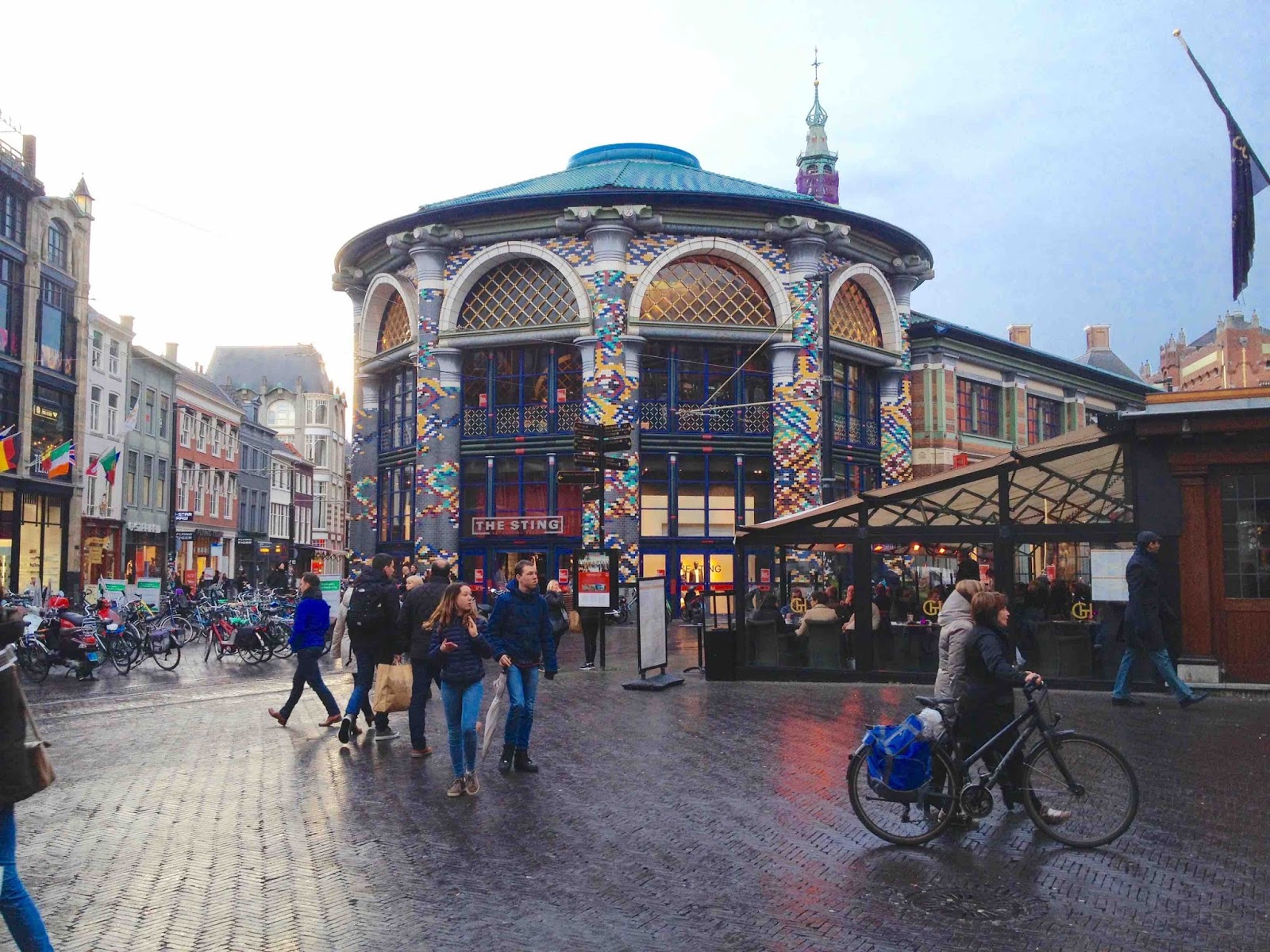
Weekend in the Hague and Delft, Netherlands

The Hague? Well, why not? I'd never been and I find it hard to say no to anywhere new, but if I'm going to be truthful, I didn't think it would be terribly... Well, isn't it best known for where they hold war crime trials? Oh, and The Girl with the Pearl Earring, of course. So let's just say that I went off for the weekend with fairly low expectations...

The first thing I always want to do when I get to the Netherlands is count windmills. So, one... And then I forgot to count any more and we did see some, but it wasn't like we were falling over them.

I'd worried, completely unnecessarily as it turned out, how we'd get from Schiphol to the Hague. In fact, it's exceedingly simple: you buy a ticket in the airport terminal, go downstairs and get on a train and–  Nope, there's nothing more to say, because that's it. In fact, that seems to be true of all travel in the Netherlands. It's always terribly simple and straightforward.

Now that we were in the Hague, how were we going to spend our time? We hadn't made any real plans, though I had various ideas: we could go look at the building that houses the International Court of Justice, we could go to the Mauritshuis and see Vermeer's The Girl with the Pearl Earring as well as plenty of other famous paintings from the Dutch Golden Era, we could eat crepes, we could... Well, that's where my ideas ran out.

What about going to the beach? Now there's a thought. So, a look at the map and yes, there was a tram we could hop that would take us right there. And, as a bonus, we could see plenty of the Hague as we trundled past.

Now here's a thing: the buildings here, whether they're official or simply family homes, are awfully pretty. So much so, that it's a delight just to look at them. That was a surprise. And here's another thing: the beach is wide, long, sandy and windy. People come to ride those land-based sailboats on it, or walk along it or eat alongside it. If it's winter, there's even a pop-up skating rink by it. However, we went for the enticing, entirely covered pier. Unlike many British piers, which can have a slightly tawdry, faded glory feel to them, this one is very jolly and surprisingly upmarket. Pulled pork? Dirty burger? Craft beer? Cocktail? Crêpes? Absolutely. And why don't you enjoy your order on a slouchy leather sofa pulled up to a roaring open fire, while the wind lashes the windows with sea spray? It's nice and warm and clearly a destination for families, couples and friends to hang out. If this all sounds far too tame, there is a bungy jump out at the end...

We were pre-booked in to visit possibly the Hague's most banging newish restaurant that evening. Mama Kelly, named after a song when the owners couldn't decide what to call it (or so our waitress told us), is housed in an old cigarette factory in what was once an industrial park by a canal. Like so many once-gritty spots, this one has been reborn as a creative hub and Mama Kelly is booked out most nights of the year, so be sure to make a reservation. It has several USPs, including a short but very good menu featuring whole North American lobsters, great French fries, delicious cheesecake and a house DJ spinning vinyls of folks like Stevie Wonder. Just a tip: this is probably the only place in the Hague where public transport won't bring you to the door, so do order a taxi.

Our hotel was the Grand Winston, which isn't strictly in the Hague, but in a district midway to Delft called Rijswijk. It's so easy to get to though, by bus, tram or train – literally five minutes via the latter mode of transport – that it makes no difference and on the plus side is already halfway to Delft, of which more in a moment. First though, I have to say what makes the Grand Winston such a great stay: one, the staff, who are friendly and helpful and have a wonderful nothing-is-too-much-trouble attitude; two, it's a calm, clean, comfortable hotel with plenty of luxury touches, like in-room Nespresso machines, huge windows and three restaurants and a bar on site, plus, you can rent bicycles here for just €7.50 per day and add a picnic for two in a pretty basket  for €25; three – and this really can't be overstated – the most amazing breakfast buffet. Plenty of choices, like umpteen kinds of breads and pastries, cold meats, cheeses, smoked salmon, eggs anyway you want them, including bespoke omelettes, sausages, baked beans and a whole gluten-free section and, absolutely best of all, especially for an American (or Canadian, I'm guessing), real pancakes with Vermont maple syrup. So delicious, it was very easy to overeat and it was still only morning....

Day two saw us heading to Delft, which was one five-minute stop on the train from Rijswijk and definitely worth a visit. It's like a dinky version of Amsterdam: all pretty canal-side merchants' houses, churches with crazy-tall bell towers you can climb – and climb and climb, cosy coffee shops and, of course, plenty of stores selling that blue and white china. You could go out to the factory if you felt like it or you could just wander the pretty canals and squares and gawp at the cheese shops, which make pretty displays in all their brightly coloured wrappers. We even saw green cheese (and, now you've seen my picture, so have you).

Back in the Hague and we checked out the shopping street of Spuistraat and Hoogstraat, filled with upmarket clothing brands and Scandi labels, and did a lot of wandering through pretty streets. Too soon it was time to leave and we still hadn't got over to the Mauritshuis or the Courts of Justice or... Well, it's clear there's a lot more than I thought in the Hague.

While we were buying our last order of chips and mayonnaise, in the Hague train station, I saw a contraption that reminded me very much of the old Horn & Hardarts – those early fast-food cafeterias where each dish was in its own little compartment and you paid to open the door to get at it – in New York City, which then reminded me how often it happens that something in a European city will be very similar to something old school in America – and then I remind myself that, really, it must be the other way around.


Monday, 8 February 2016

Uzès toward Moulin des Carrières

Day 3 or possibly 4, and having explored the Vallee de l'Eure in one direction, when the sun came out a second afternoon in a row, it seemed like a good excuse to explore in the other. The waymarker said Moulin des Carrières, 0.6km, but I walked more than that and never came to a windmill.

Nevermind, because what I did see was amazing enough. A path made from a natural stone ledge. Is this what the Romans walked along as they plotted their aqueduct? Or maybe just made their way to and from Nîmes? Who knows? But it's certainly an interesting walkway.

The reward for following it was a very Mediterranean-feeling bend, with those very particular sorts of pine trees that I've only ever seen this far south.

And then, around this bend, a fantastically constructed dry stone wall, worth the trip all by itself.

The path split here and both options seemed to go on and on, neither promising a windmill though. It seemed then, that it must be time to turn around and head back, along that extraordinary causeway of stone.

All this walking has made me bolder though. After getting back to town, I went to the tourist office to find out about buses to nearby St Quentin la Poterie, because I'm keen to check out the Friday market there and the pottery it's named for. The buses, it turns out, run there at 8.35am latest, with the first returning one at 13.10. As it's only a 5-minute bus ride, that leaves a LOT of market time. Probably too much. But then a little digging and I learn it's less than 5km from Uzès. Who needs a bus? I'll walk...