Friday, 9 September 2016

Majorca in September


When the directions for finding our villa ran to three pages, a wariness took hold. I've been on many a trip that's started out so well – flying along a motorway, watching the klicks add up, making great time – only to lose it all and plenty more crawling along dark country lanes at night, trying to find the 'tall cypress tree just before the bins, then turn into the small lane on your right...'

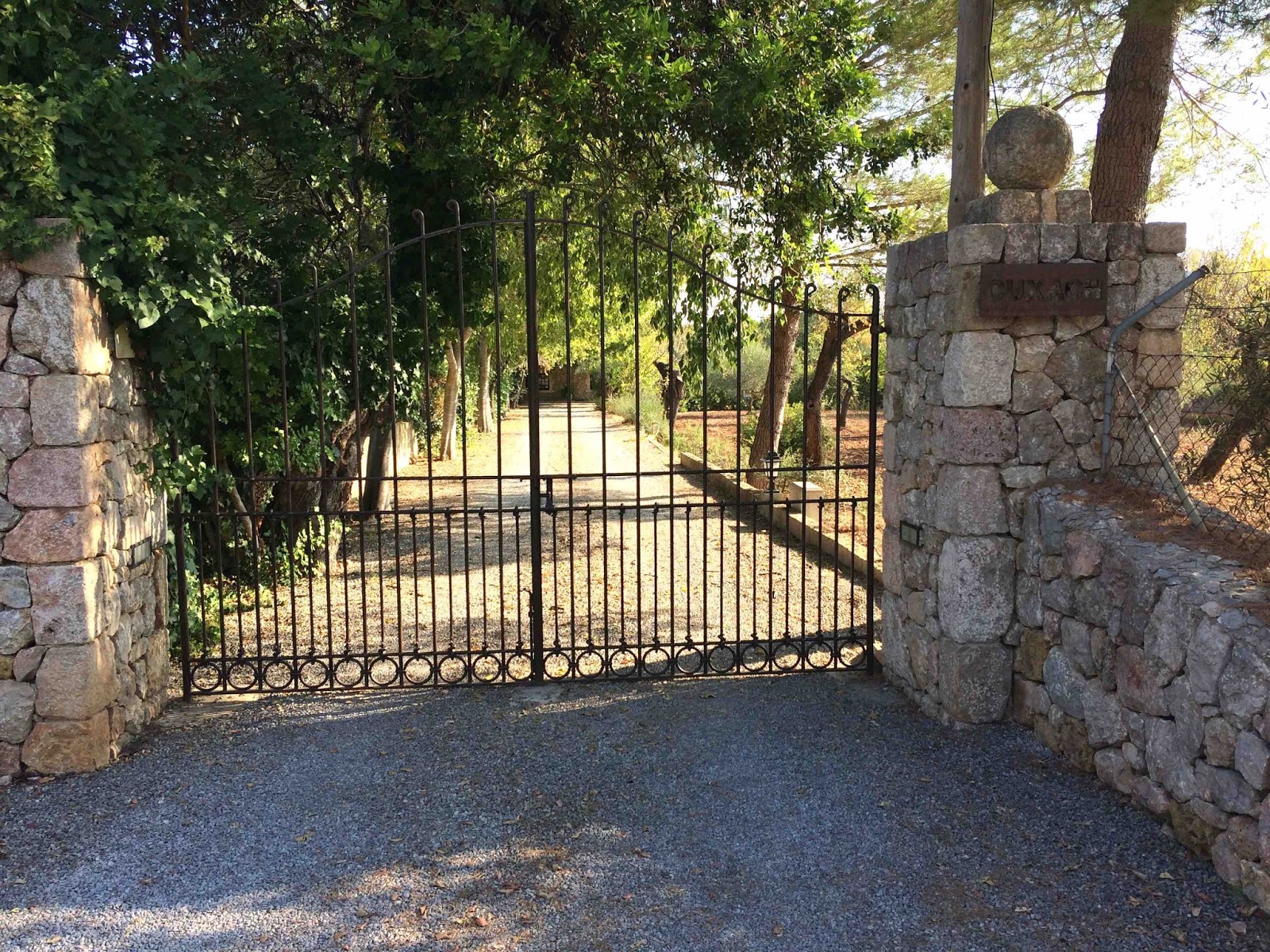
I needn't have worried. Our destination, in the north-east of the island, in beautiful countryside between Pollença and Port de Pollença, was exactly where described. We arrived in 55 minutes with no kerfuffle of lostness and there it was: the wrought-iron gates, the wooden sign to the side, Finca Cuxach, and the key where we'd been told it would be.

Finca means farmhouse and Cuxach retains all of its rustic, traditional charm – bare stone walls, whitewashed inside, which are an arm's length deep; beautiful sandstone blocks for windowsills and doorways; tiles underfoot; ceiling beams and a terracotta roof; along with pretty still-life arrangements on mantelpieces and table tops – think earthenware bottles of varying sizes, a row of ladles along a wall, a mounted blue-flowered bowl and plenty of scatter cushions.

There are three bedrooms – one double upstairs with its own en suite bathroom – two down (one double, one with twin beds), along with a second bathroom all off on one side of the central entry hall/sitting room. To the opposite side is a large room with kitchen, dining and living space, so that, from the outside, the house looks entirely symmetrical.

Along with all the rusticity is fast wifi, satellite TV, CD player, microwave, dishwasher and all the usual kitchen gadgets and appliances, plus more than enough airport-bought paperbacks to keep you going for years if you forgot to bring anything to read. Outside is an enormous, shaded terrace with two eating areas, so you can mix it up or choose whichever is getting the darkest shade.

I've saved the best for last: a crystal clear, delightfully clean and sparkling-in-the-sunlight pool. It's the sort of amenity that has you saying, wherever else you may visit, "Shall we just go back to the villa?" when presented with possible ways of spending the rest of your day. Because it's quiet, peaceful, private. I literally had a moment when I felt the stress leave my body, lying on a lounger, listening to the nearby cockerell crow and realising there was nothing to do but just be.

Cuxach isn't in the middle of nowhere, but in an area of both working farms and high-end villas, some restored fincas, like ours, others more-recently built, but clearly with a lot of money. We couldn't see our neighbours, though we knew they were there, which is fine.

You might be thinking that, as we came in September, it would be cooler and this is the case at night, when you wake up searching for the sheet, but daytime temps were hovering around 30-31°C (that's upper 80s for you fahrenheiters), which is hot enough. We made it out of our domain every day and these were the highlights I'd recommend:

1. Formentor Lighthouse. Yes, everyone does it, but there's a reason for that. The winding road takes you past astonishing vertical drops and views that make you reach for your camera.

2. Port de Pollença. For the waterfront promenade, for the ice-cream kiosk at the Yacht Club Roundabout, for the people watching from a harbourfront café and probably for dinner one night. It's also the place to pick up one of the many boat excursions. We went on a half-day trip with the Maria Isabel, which promises no more than 12 guests and is a beauty of an authentic Majorcan sailboat.

3. Pollença itself. Probably the most beautiful of the Old Towns, with lovely squares, an astonishing church – it looks deceptively plain from outside, inside it's more heavily painted and ornate than Westminster Abbey – little one-off shops and plenty of dinner possibilities.

4. Alcudía, which made me think of a mini-Avignon with its castle-ly fortifications. The street market, which we found on a Tuesday, was a jolly affair and there was plenty of delicious fresh produce which is bound to tempt.

5. Palma, under an hour away – we did it in 50 minutes without breaking any speed limits – is definitely worth a day trip. Take a walk past the marina to gawk at the super-yachts, wander the Old Town streets, visit the Cathedral if you must, then collapse at a pavement café.

The best reason to go in September though, is that the summer crush has gone home to school timetables and jobs, and while there are visitors here all year round, it's simply that bit emptier and quieter, but totally still feels like summer.

Our villa came through TravelOpo. It sleeps six and prices start from £850 pw.

Oh, one last thing you might want to do here: look at the stars...

Saturday, 6 August 2016

Island hopping near Athens


Das Boot

Have you ever thought, "This can't be my life – I must have stumbled into someone else's"? That's pretty much how I felt for the entire long weekend I went with a small group of friends who'd hired a ginormous (motorized) catamaran that we picked up in Pireas, the Greek capital's port.

Did someone say hot? Was like being steamed. Walking became syrupy, water was drunk like, well, water. We spent one night in what was likely the red-light district – but was a perfectly decent hotel – then stocked up in the morning with food and drink and set off...

Once out of the harbour, the ocean breeze took the heat off. First thing was getting the far side of the shipping lane, next thing was heading to Poros, an island on the other side of the Saronic Gulf from Athens, so not too far a ride – maybe 90 minutes?

We moored in a lovely bay with a taverna on the beach and some of us swam in for a coffee, while others of us just swam off the boat and generally lazed about in the sun. See? Whose life could this be? Surely not mine...

Poros Town
Next stop was Poros Town, where we docked with much instruction from the local restaurateurs hopeful for a large party for dinner (sorry!) and then a walk-about. Back came the full force of the heat – boom – like a heavy cloak, so that every step felt a little too far, but what a pretty place. The stone-cobbled street that ran one block in from the touristy-tat-filled harbourside had bakeries run by mom and pop, the fittings installed back in the 1940s or 50s still in place. Like stepping back into a movie set of old-time Greece.

Mandraki Bay
Me trying to tie a bowknot
Next day, we had to wait for all the boats that had moored up against us – three or four deep – to leave before we could – though to be fair, it didn't really hold us up. Today's sailing was to Hydra, a long skinny island just around the mainland from Poros and maybe a 45-minute ride further. Here we moored again, this time in a smaller bay, called Mandraki (population 11),  but with the requisite taverna and this time I swam in with the others. How unutterably perfect is it to climb dripping out of the sea, sit down at a pretty wooden table under a grape-vine-clad trellis and order feta-cheese topped salads, eating while you dry off? None of the simple ingredients – tomatoes, cucumber, green bell pepper, oregano – ever taste so good anywhere else but in this setting.
Hydra

In the evening, we took a water taxi from the boat round into the next bay, where Hydra Town itself is. For over 300 years, Hydra belonged to Venice (almost until the end of the 16th century) and you can see this in the style of the pretty townhouses. There are also a number of notable mansions here and fortifications left over from the Greek War of Independence from the Ottoman Empire. Rumour has it that Leonard Cohen has a place on Hydra. We ate dinner at Zefyros, which was cheap but delicious – choose lots of mezze plates and share. It's just down the furthest-left-hand street that leads off the harbour if you're standing with your back to the water.

Goodbye Hydra
One more thing about Hydra: there are no motor vehicles, so the only way to get around is by horse, mule or donkey. Oh, and by boat...

What? We have to go back to Athens and fly home? In that case, please let's leave it to the last possible moment. Yay, everyone else feels the same and so we pootled on from Mandraki Bay to Egina, the island closest to Athens and so naturally a little busier, for a last swim in to a beach taverna, a last fizzy drink under a canopy while the hawkers come by trying to sell everything from watches to solar phone chargers. One of our party had a look at everything and
eventually just gave one of these men €10 but didn't buy anything –  to the man's initial confusion and then gratitude.

Hello again, Athens. Maybe next time I'll get to see your sights (but only if it's at least 20° cooler...).


Athens in the distance


Wednesday, 6 July 2016

24 hours in Barcelona

Shhhhhh. Top secret. That's the way on film sets. So I'm afraid I can't tell you what I saw (except that it was very cool) or what was being filmed, but I can tell you that I was sent to Barcelona (orginally*) for just one day, flying in first flight, leaving on last, to write a behind-the-scenes piece on the making of a TV advert.

Wait, I'm being given a round-trip ticket to Barcelona? Does it matter then, when I use the return? No? Then I'll come back the following evening, thanks very much. Oh, and can I review a hotel while I'm there? Yes? Fabulous! That means I'll have 24 hours to explore the city.

The filming took place inside a huge exhibition hall-type place, right by the bottom of the steps leading up to the National Museum of Calalan Art. A hefty climb up in the summer heat is worth it for the fabulous views alone (I can't vouch for what's inside, because I didn't have time to go in) and if you walk around the back, you can see the park and buildings left over from the 1992 Olympics. Yet more tantalising possibilities for exploration, but for another day...

My kotch for the night was Room Mate Carla, on  Carrer Mallorca. It's cool, calm and quiet downstairs, with a very sensible noon check-out, so you can totally take your time over the vast, help-yourself-buffet breakfast. Best of all, to my mind, was the room. Huge, with heaps of storage (if only I were staying that long!), a comfy sofa, a big bathroom with heaps of lovely smellies to wash, scrub and moisturise yourself with and – oh joy! – a balcony overlooking the street with a side-on view down to the spires of the Sagrada Familia.

In case you don't know, this was to be architect Antoni Gaudi's masterpiece. A drip-sand-like castle of a cathedral he started building in 1883 and had not finished by the time of his death 43 years later in 1926. A great unfinished masterpiece which, though construction continues to this day, "will never finish", or so said my taxi driver with a mixture of affection and ruefulness.

In the morning, after a delicious sleep on the enormous bed and filling up on croissants, eggs and fruit, I left my bag at reception and walked to the cathedral. I didn't go in – too many people and I'm not great with heights, but it's worth a slow walk around and I found my new favourite tree: jacaranda. These are the astonishing purple-flowered ones throughout the little park square in front.

The best way to see any city? On foot. And as I love architecture and the unusual, Barcelona is perfect, with so many beautiful buildings by Gaudi which he did, thankfully, finish. It's an easy city to walk around too, because much of it is on a grid. I took off in the general direction of Casa Batllo, which Gaudi didn't actually build, but did completely re-fashion.

Along the way, I came upon one of Barcelona's many covered markets. You've probably heard about La Boqueria, the huge one just off La Rambla, but I actually preferred this smaller one. For a start, it wasn't rammed and it also had the feel of a neighbourhood place, where folks were picking up food for their families, treating their young children-in-tow to a freshly made fruit drink. I had a cup of strawberry and coconut for a euro, which I drank as I walked around admiring the displays of food.

Then back out into the fray and on to Passeig de Gràcia, which is heaving with tourists and the now-ubiquitous selfie brigade. Here's a thing: when I was growing up, we were given to understand that it was somehow a) not cool and b) not dignified to be so into oneself. Now it's perfectly acceptable. But you knew that.


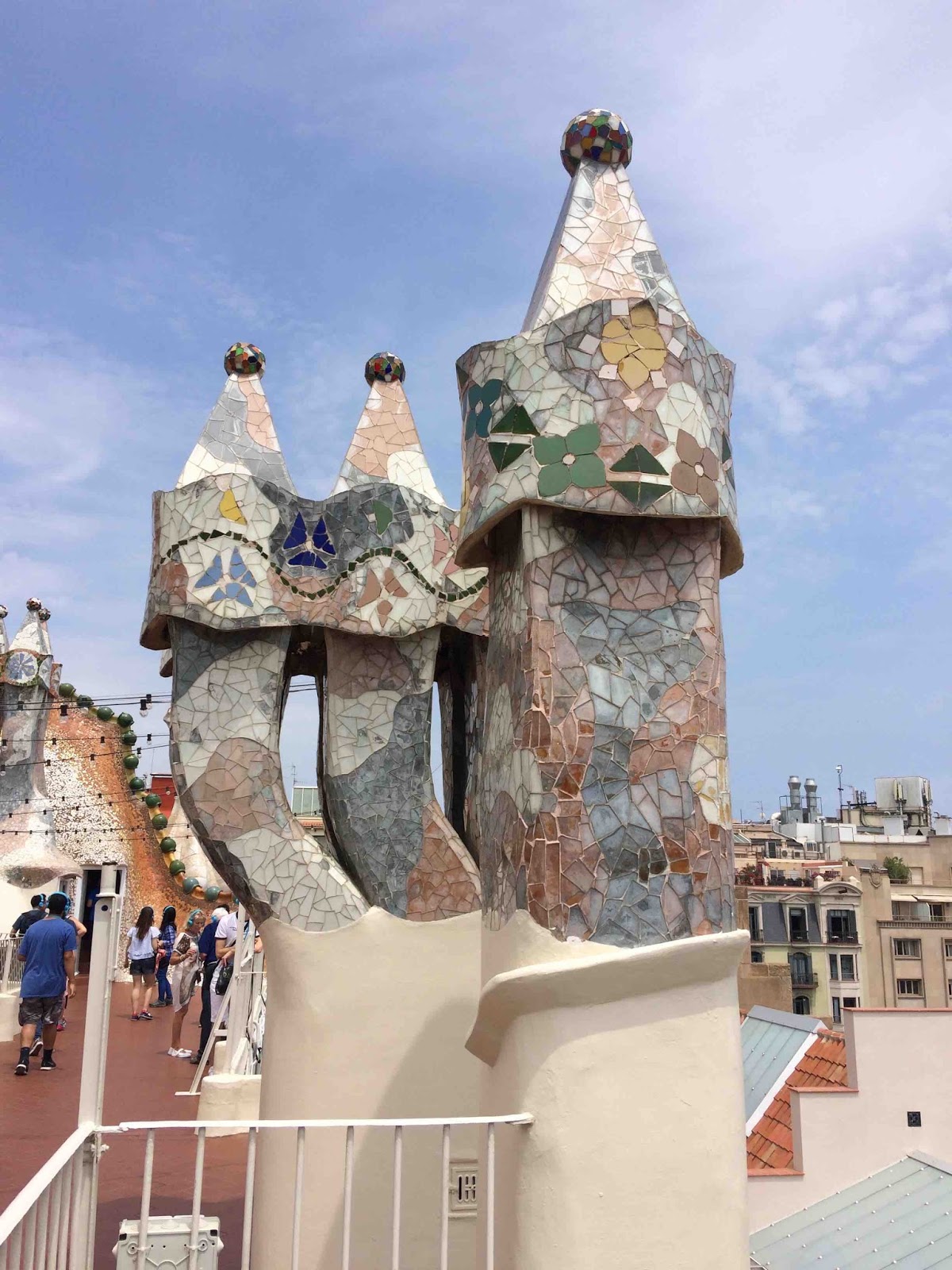
There are actually two Gaudi-re-fashioned buildings next door to each other here. Casa Batllo is the one on the right and was the private home of the Batllo family, so inside are a number of private apartments for the different members. The audio guide tells you there are no straight lines, but I did spot a few. It also tells you about Gaudi's influences and passions. You can spend as long as you like inside, which makes it worth the fairly hefty entry price, but if you're only going to visit one paid-for thing while you're in town, I'd choose this. Also, though the city was crowded the day I was there (a Saturday in early June) it really wasn't too bad inside. 


As well as all the obvious things, like the tiles and the glass and the woodwork, I was struck by the simpler, plainer details, like the air/light vents along the corridor on the top floor, which served as servants quarters and the washing rooms. There was a lovely, very simple wardrobe in one room too. 

One could go on and on about how interesting all the bits of this house are and I could easily fill this whole blog with pictures of it, but best is to go see it for yourself. 

From here I walked down to La Rambla – of course. You sort of have to and, anyway, if you ignore the tourist tat, there are some interesting buildings and it takes you down to the much revamped harbour area. The last time I came down here, it was all a bit dingy and seedy. Now, million-euro yachts moor and a whole floating addition to the city has been constructed called Port Vell. 

This is where I stopped for some perfectly decent tapas and to recharge, before walking on past a different sort of market selling clothes, as well as plenty of Africans selling counterfeit sneakers and sunglasses on the pavement.

Eventually, I made it to my goal: Barceloneta, the man-made beach, created in time for those Olympics, and what a great idea. The city clearly needed this beach and it's very popular. It sits just off the area where the fishermen traditionally live and there's clearly a bit of annoyance at the hipsterfication of the old neighbourhood, as evidenced by the signs hanging off the apartments. Still, I doubt they'll stop the spreading crop of quinoa-salad cafés, bicycle shops and coffee places that have taken root here.

I had just enough time to dip my toes in the water before walking lickety-split back to Room Mate Carla, picking up my bag and catching the train to the airport. Phew! All in good time, though I'd walked a good 18km, according to my iPhone anyway.

But what's this? My flight's been cancelled? No way! Yes way. We got put up in a Novotel midway between the airport and Barcelona, fed almost-tasteless pizzas that had clearly been bought frozen by the dozen. What a come down after the lovely Room Mate Carla and my fascinating day! Still, there was a camaraderie of sorts between my fellow detainees, and all was well that ends well, as the next day was Sunday and nothing, really, was lost. Ah, yes, that *. So, I lied: I was there longer than 24 hours, but you get the idea...


Barceloneta


Monday, 13 June 2016

Cornwall: Where to stay from Ruthernbridge near Bodmin to coastal Mawgan Porth


If it's May it must be time for a road trip and this year Cornwall was on the cards. First stop, Ruthern Valley Holidays, by Ruthernbridge. This sounds like a 1950s-style holiday camp, doesn't it? But it's very modern in the best way. The owners – a couple with two nearly teenage boys – are keen to keep it green. So showers for the campers are solar heated, eco-lodges are well insulated and waste is recycled. It's true they have a row of older-style cabins, but these have their own retro charm – plus two bedrooms, a comfy living room with picture window and well-equipped kitchen.

Or, if you'd rather, on site you can camp, pull up in a motorhome, stay in a wooden wigwam or even a static 'mobile' caravan. There's a children's play area, a stream with fairy-like bridges in the woods for make-believe games, pigs, chickens, a small shop for essentials and local produce, plus bike hire and a Gold David Bellamy Conservation Award 17 years in a row.

Walking (or cycling) distance away is the Camel Trail – once a railway line, now an 18-mile bicycle, walking, riding trail that's pushchair and wheelchair friendly, and along the way – as well as beautiful countryside – there's a tea garden and, when you get to Helland Bridge, the wonderful studio of internationally reknowned ceramicist Paul Jackson. If you're lucky, you'll find him at work on one of his beautiful pots or plates, and can also have a look round his pretty garden.

Next stop was Gwel an Mor, a five-star luxury holiday resort by the coastal town of Mawgan Porth and just 45 minutes' drive further into Cornwall from Ruthernbridge. Here you have two kinds of accommodation to choose from: Scandi-style wooden lodges, with the bedrooms downstairs and the open-plan living space upstairs, for taking full advantage of the far-reaching views over to the sea; or the very modern, one-level Residence lodges, which are ultra-futuristic, highly eco-efficient, with so much floor-to-ceiling glass it's hard to tell where outside ends and inside begins.

All the accommodation at Gwel an Mor has hot tub and word-burning stove as standard, and are designed to give maximum privacy. We were told, for instance, that they were nearly full during our stay, but we certainly never heard anybody else's noise and barely saw anyone else either!

Happily, Gwel an Mor is dog-friendly (though some accommodation is kept pet free, so don't worry if you have allergies); there's an indoor swimming pool; an on-site spa with a wide choice of relaxing treatments; gym, restaurant, bar, putting green, bicycle hire, tennis and – best of all – the Feadon Farm Wildlife Centre. It's an incredible resource, as is Gary, who runs it and you can't leave without enjoying at least one of the 'experiences'. There's a meet the animals visit, where participants can feed goats, chickens, reindeer and foxes, plus meet and learn all about Britain's diverse wildlife; try falconry; go on a badger watch; take a night walk or go rock pooling, all with Gary's knowledgeable commentary and presence. This is a unique conservation centre and there's nothing else like it in Europe.

If you're feeling energetic, head for the Coastal Path. Spring is an excellent time to visit down here. I've never seen so many wildflowers blooming at once – we even saw wild orchids, a first for me. As my companion has the Duracell-battery-like energy, we walked the path all the way to Rosehill Cottages in Porthtowan, just over 4 miles away – and back again...

You pass a strangely eerie, seemingly abandoned army range that's heavily fenced off, and also old bits of tin-mining buildings and closed up entrances along the way. We had the good fortune to meet a chap coming up from the cliff edge in a wetsuit and wearing a headtorch and carrying a bucket. What had he been up to? Oh, just exploring an old mine, now filled with sea water, that went 30 metres down. He explained that he's been excavating this particular mine for years. His occupation? He's the guy who accompanies submarine folk into their waste tanks to make sure they follow health and safety procedures. So. He works underwater, in a tank that's in a submarine. And his hobby is going 30 metres under water in an old mine shaft. I think we can safely say this guy doesn't have claustrophobia issues.

Rosehill Lodges is another five-star eco-stay (can you see a theme here?). The cottages have soil roofs, with grass and wildflowers growing on top of them and they're all cleverly blended into their environments so you almost don't notice them. However, again, these are upmarket stays, with all mod-cons and comforrt to the fore. And hot tubs. What is it with hot tubs, anyway? They seem to have become de rigueur.

So, Cornwall is good for cycling, walking and... eating! We found farm shops that sell gluten-free pasties, vegetarian pasties, local fruit and vegetables, plenty of homemade produce, like jam and scones and, of course, clotted cream (don't say yuck until you've tried it). What we couldn't find and not for lack of trying? Fish! There was the sea, but where was the local catch? A mystery to be solved one day I hope....


Scandi lodges at Gwel an Mor at sunset