Monday, 13 June 2016

Cornwall: Where to stay from Ruthernbridge near Bodmin to coastal Mawgan Porth


If it's May it must be time for a road trip and this year Cornwall was on the cards. First stop, Ruthern Valley Holidays, by Ruthernbridge. This sounds like a 1950s-style holiday camp, doesn't it? But it's very modern in the best way. The owners – a couple with two nearly teenage boys – are keen to keep it green. So showers for the campers are solar heated, eco-lodges are well insulated and waste is recycled. It's true they have a row of older-style cabins, but these have their own retro charm – plus two bedrooms, a comfy living room with picture window and well-equipped kitchen.

Or, if you'd rather, on site you can camp, pull up in a motorhome, stay in a wooden wigwam or even a static 'mobile' caravan. There's a children's play area, a stream with fairy-like bridges in the woods for make-believe games, pigs, chickens, a small shop for essentials and local produce, plus bike hire and a Gold David Bellamy Conservation Award 17 years in a row.

Walking (or cycling) distance away is the Camel Trail – once a railway line, now an 18-mile bicycle, walking, riding trail that's pushchair and wheelchair friendly, and along the way – as well as beautiful countryside – there's a tea garden and, when you get to Helland Bridge, the wonderful studio of internationally reknowned ceramicist Paul Jackson. If you're lucky, you'll find him at work on one of his beautiful pots or plates, and can also have a look round his pretty garden.

Next stop was Gwel an Mor, a five-star luxury holiday resort by the coastal town of Mawgan Porth and just 45 minutes' drive further into Cornwall from Ruthernbridge. Here you have two kinds of accommodation to choose from: Scandi-style wooden lodges, with the bedrooms downstairs and the open-plan living space upstairs, for taking full advantage of the far-reaching views over to the sea; or the very modern, one-level Residence lodges, which are ultra-futuristic, highly eco-efficient, with so much floor-to-ceiling glass it's hard to tell where outside ends and inside begins.

All the accommodation at Gwel an Mor has hot tub and word-burning stove as standard, and are designed to give maximum privacy. We were told, for instance, that they were nearly full during our stay, but we certainly never heard anybody else's noise and barely saw anyone else either!

Happily, Gwel an Mor is dog-friendly (though some accommodation is kept pet free, so don't worry if you have allergies); there's an indoor swimming pool; an on-site spa with a wide choice of relaxing treatments; gym, restaurant, bar, putting green, bicycle hire, tennis and – best of all – the Feadon Farm Wildlife Centre. It's an incredible resource, as is Gary, who runs it and you can't leave without enjoying at least one of the 'experiences'. There's a meet the animals visit, where participants can feed goats, chickens, reindeer and foxes, plus meet and learn all about Britain's diverse wildlife; try falconry; go on a badger watch; take a night walk or go rock pooling, all with Gary's knowledgeable commentary and presence. This is a unique conservation centre and there's nothing else like it in Europe.

If you're feeling energetic, head for the Coastal Path. Spring is an excellent time to visit down here. I've never seen so many wildflowers blooming at once – we even saw wild orchids, a first for me. As my companion has the Duracell-battery-like energy, we walked the path all the way to Rosehill Cottages in Porthtowan, just over 4 miles away – and back again...

You pass a strangely eerie, seemingly abandoned army range that's heavily fenced off, and also old bits of tin-mining buildings and closed up entrances along the way. We had the good fortune to meet a chap coming up from the cliff edge in a wetsuit and wearing a headtorch and carrying a bucket. What had he been up to? Oh, just exploring an old mine, now filled with sea water, that went 30 metres down. He explained that he's been excavating this particular mine for years. His occupation? He's the guy who accompanies submarine folk into their waste tanks to make sure they follow health and safety procedures. So. He works underwater, in a tank that's in a submarine. And his hobby is going 30 metres under water in an old mine shaft. I think we can safely say this guy doesn't have claustrophobia issues.

Rosehill Lodges is another five-star eco-stay (can you see a theme here?). The cottages have soil roofs, with grass and wildflowers growing on top of them and they're all cleverly blended into their environments so you almost don't notice them. However, again, these are upmarket stays, with all mod-cons and comforrt to the fore. And hot tubs. What is it with hot tubs, anyway? They seem to have become de rigueur.

So, Cornwall is good for cycling, walking and... eating! We found farm shops that sell gluten-free pasties, vegetarian pasties, local fruit and vegetables, plenty of homemade produce, like jam and scones and, of course, clotted cream (don't say yuck until you've tried it). What we couldn't find and not for lack of trying? Fish! There was the sea, but where was the local catch? A mystery to be solved one day I hope....


Scandi lodges at Gwel an Mor at sunset


Saturday, 14 May 2016

Maison Bleue and The Ickworth, Bury St Edmunds, Suffolk

Someone said to me recently that, unless blogs were about the bad things that happened to people on their travels, they weren't very interesting. I sort of know what she means, but I'm afraid I'm going to have to disappoint this time...

I recently had the exceptional good fortune to stay at a place I've been in love with for a very long time. Ickworth House, near Bury St Edmunds, is beautiful. Once the home of the Hervey family, it was passed to the National Trust back in the 1990s and now, for the very good fortune of all those who wish they'd been born with a silver spoon in their mouths, the East Wing has been turned into an extremely comfortable hotel by the Luxury Family Hotels group. It's been done with a light touch, though, so a stay here feels as if you've gone to visit some very well-heeled chums. The library is stocked with books floor to ceiling, with some unusual family artifacts – we noticed a pair of ancient, obviously many-times worn soft shoes in a glass case; there were some framed newspaper articles about various Hervey family members and a box of toys had been left by a sofa. The sitting room has much the same feel, with groups of exceedingly deep, comfy sofas and armchairs, with tables placed at just the right distance to hold your aperitif or digestif, and through this you can take yourself to the elegant dining room – probably the only child-free room in the place (have I mentioned children are positively welcomed at The Ickworth?).

At the end of the corridor is a large, airy, conservatory-style dining room where guests can eat all three meals a day en famille – including a children's high tea, served from 5-6pm – and downstairs, along the stone-floored passage, various intriguing rooms lead off. For instance, you might want to have some fun in the games room, where there's air hockey, table football, Wii, PlayStations and ping pong. Or there's the Four Bears Den, where you can drop in with your little ones or let Mary Poppins types look after them (from ages 3 months to 8 years) for two hours per day per child for free (but do book this in advance). Why would you want to be parted from your precious darlings? Why, to go to the spa, of course, which is just a skip further down the passage. There are various treatments on offer, but you won't go wrong with a back, shoulder and neck massage... Finally, there's also a cinema room down here, with a nightly family-friendly film, followed by a more grown-up one. It makes a good spot to play board games or cards during the day.

Rooms come in all sorts of configurations to suit various family groups or couples, so you can have a cot or extra bed brought in to your room for your child(ren), get interconnecting rooms or take a suite. Best of all is that out of the windows are far-reaching views across the estate, where the tenant farmer grazes his sheep, as his father did before him.

Outdoors there's a swimming pool – again, open to families at all times – a playground, formal gardens, acres and acres of grounds to roam – and there's free bicycle borrowing – a National Trust tea room and shop, plant sales and free entry to hotel guests to the Rotunda, where well-informed guides can talk you through each room or simply answer any questions you might have. A visit here is a real glimpse into how the other half– OK, the upper echelon – live, but because you can skip next door to the 'house', it all feels a bit yours.

We had dinner at The Ickworth one night (very delish, definitely book in for this) and one evening, took ourselves in to nearby Bury St Edmunds to eat at Maison Bleue.

What a surprise! Forget the image you might have of a quaint old market town. Maybe because it's the site of the signing of the Magna Carta, maybe it's because it's always done quite well through the local brewery, but this place feels sophisticated. And, fittingly, it has an extraordinarily good French restaurant serving a modern take on this cuisine.

Owned and run by a French couple, chef Pascal and front-of-house Karine, the decor is all French grey, white tablecloths and touches of dark wood – very grown-up and soothing. Except for two facts – all the staff speak English with lovely French accents and the produce is mostly sourced from the British Isles – you could be eating in France. Every detail has been considered, from colour to taste to texture and we very quickly realised that Pascal must be something of a chemist. Flavours were juxtaposed just so, to bring out the essence of each ingredient. For instance, our amuse bouche was a cauliflower tartare with parsnip crisp. Slightly more than a mouthful, it was exquisite and definitely had us sitting up, excited for what was to come.

We went for the astonishingly well-priced three-course set menu, which costs just £36.50 including VAT. Rather than limiting us, we had a fantastic choice from four starters, four main courses and six desserts – but more about that last course in a minute. To keep us occupied, we ordered the bread – three kinds, all artisan made and served with Brittany butter. This was almost a mistake, because they're so good it's impossible not to eat them all....

I relied entirely on the sommelier, who paired just the right glass of wine with each course, and recommend you do this as well, to get the full experience.

Our starters were spring vegetables with English green asparagus, baby heritage carrot, feta, zucchini, garden pea, smoked eel, gnocchi and Parmigiano for me; cream of fennel soup, smoked haddock, moooli and toast for my companion. I want to rhapsodise about how good these were – all the vegetables were cooked just to the point of being easy to eat without losing any of their flavour – but it's worth keeping in mind that the menu changes daily. Yes, daily. This means Pascal must be endlessly creative and imaginative, because he uses only what's fresh each day and, since the menu is seafood-centric, it obviously relies on what's been caught.

For mains, I had the filet of Isle of Gigha halibut, celery, shallot confit, soft meringue; my companion filet of Devon coast line-caught turbot, buttermilk, lemon confit, samphire grass, grilled spring onion. Suffice to say, they tasted as good as they sound. The fish was cooked to perfection – never dry or tough, always moist and full of flavour. For our sides, we chose crushed purée of Hall Farm potato and a dish of the vegetables of the day.

A word here about small things: the potatoes, like the bread, were simple but, equally, simply delicious and could have been a meal in themselves.

At this point we were seduced by the cheese trolley. The only word to describe it is heaving and part of the pleasure is having each one described by a pretty voice overlaid with that French accent.... There are blues, creamy ones, soft ones, hard, goat, sheep, cow, strong, mild... You get five, which are served with grapes, caramelized red onion chutney, red onion with sage in chilli jelly, honey and fig biscuits.

We were more than full and definitely satisfied, but as a wise person once said to me, there's always room for desert. So yes, we managed to fit them in: a café crème of coffee and azelia Grand Cru chocolate soft ganache, buckwheat ice cream, brioche and caramelised cashew nuts for my companion; poached Williams pear, beetroot caramel, vanilla ice cream, milk espuma and sesame seeds for me. The sesame seeds were somehow the star, bringing out the flavour of the pear and I enjoyed every mouthful.

Do you remember the start of this entry? About how only bad experiences are interesting? Well, if you hold with that, then you may take some schadenfreude from reading this: I was almost too full. Yes, my eyes had been bigger than my stomach. The trouble is, I can't tell you what I wish I hadn't eaten, because it was all so good.

How wonderful then, to waddle out into the night and head back to our stately home. Ah, yes, how the lucky ones – us this time, you next? – get to live...

Tuesday, 15 March 2016

Where to ski: Châtel, Haute Savoie, France

Wondering where to go skiing? You could do worse than my favourite French Alp destination, Châtel. I almost hate sharing this tip, because it's not overrun and I'd hate to see it get crowded. On the other hand, it's so great it deserves a bit of a plug.
For a start, it's an actual town, as opposed to a resort, so it has all the things a real place should, like boulangeries, a marie, a primary school, a weekly market (Wednesday mornings), a little supermarket, laundromat, post office, pharmacy and two cinemas, as well as, of course, bars, restaurants and plenty of gift shops. It's the sort of place where you keep bumping into the same school group or recognise the chap who fit your skis when he's coming back with his baguette. And? He'll recognise you too. 

It's part of the massive Portes du Soleil ski region, which encompasses 12 resorts, some in France, some in Switzerland. The idea is that you could, in theory, ski from one to the next, taking in hundreds of kilometres of pistes (and off-pistes) of skiing. In truth though, having skied from Avoriaz to Châtel last winter, it's actually more exciting to ski from one country to another (which can also be done from here). Most of the domains offers plenty enough skiing to see you through a week, so it's not necessary to buy that all areas pass – unless you're hell bent on racking up the klicks...

One of the things I like about this place is the old chalets, none of which seem completely abandoned and some of which seem to have been half done up – literally half. Like someone's cut it in two and fixed up one side only.

But to the skiing... It's spread out along a valley, with plenty of buses (free to lift-pass holders, though no one ever checks so you could in theory get on without a lift pass too) to take you from one feeder lift or gondola to another, starting with Abondance at one end, through Petite Châtel, Châtel, Linga and then Pre-La-Joux at the end. You could also ski from one to the next, if ability is no object (don't try it if you get nervous on anything trickier than a blue though) and they get busier as you go along, so Petite Châtel, for instance, is where you'll find yourself alone on a run and Pre-La-Joux can look a bit like an anthill when it's at full throttle. No. That's an exaggeration, but it's is definitely the busiest end. Which we couldn't quite get, because Châtel, to our minds, was the nicest area.

We stayed at Hotel L'Edelweiss, a one-star chalet-style hotel about a five-minute walk from the bus stop, 10 to the Super Chatel gondola, depending on how fast you can walk in ski boots carrying skis (or a board, of course). It is an uphill walk, but the plus side is it's downhill at the end of the day. Also, if you hire your equipment from the very nice people at Vincent Sport (where, helpfully, they speak English), you can leave it all there and pick up and drop off en route every day. And Vincent Sport is literally across the street from the bus stop and five minutes' walk from that gondola.

Dinner at L'Edelweiss is good: €16 gets you the set, three-course menu, which features local specialities, like tartiflett, raclette and the local lake fish. They will also accommodate a vegetarian, and were happy to make me an omelette or pasta. Our room was basic, but perfectly comfortable and clean, wifi was fast and there was even a TV, though we never got round to turning it on.

There aren't many black runs, but plenty of reds and blues. For the wide, gentle runs, head to the back of the mountain looking toward Switzerland. Having said this, the better skier of the two of us found plenty to keep him occupied during a week and often had the steeper pistes to himself.

I have to admit though, I've reached the point where it's not long before I'm already ready to throw myself into one of those sloping rockers and catch a few rays, and lunch always tastes better eaten at a piste-side restaurant surrounded by those beautiful mountains.


Saturday, 20 February 2016

Avignon, southern France

I had exactly 1 hour and 40 minutes to visit Avignon. It was a bit like being Cinderella, as I was tied to the A15 bus schedule and needed to be back in time for the dogs' afternoon meal and walk... So, I planned my trip to the minute.

Fortified 13th-century walls are kind of what it's all about here. Oh, and some bridge... 

The walls are pretty cool and astonishingly intact but, once you're inside them, there's some pretty amazing modern architecture. I spotted an art deco cinema on a side street and had to go take a closer look, being that it's one of my favourite styles. It's the fonts really, that do it for me. 
And then, back on the main drag – Cours Jean Jaurés – there was this amazing art nouveau building, just sitting there like it was no big deal. I was aiming for the bridge though: real name Pont St-Bénézet. I wasn't going to have time to make a visit to the Palais des Papes worthwhile, but it looks impressive and there's a crazy building opposite. That is, everything about it is just ridiculously enormous: the decorations, the scale of the façade and the way there aren't any windows above street level. I wish I could tell you what it was (if you know, please tell me!), but I pretty much just scuttled past, following the signs for Pont St B. I'd used up some of my precious alloted time by shopping. I know! Quelle horreur! But there are a lot of shops lining that Cours Jean Jaurés. Just warning you, is all.

There's a €5 admission to get into the bridge bit, but once you've paid full price to get into one of the historic landmarks in this town – and there are several, including the Palais and a number of museums – you get a stamp on your admission ticket and this gives you a discount to all the others if you visit the same day. The entry fee also gives you a hand-held audio guide, which was useful. 

Obviously, once upon a time the bridge went right across the Rhône and over the two islands in the water here, but seiges and floods have taken their toll and now there's just this spur. It has a sweet little chapel on it, where a plaque announces it's been the site of 'many miracles'. 

There are various extras in the gatehouse: a downstairs exhibition and cine area, for instance. I recommend you go with a more generous time allocation, because it was about this point that I realised I'd need to hoof it back pronto to get that bus... 

Just a tip: the bus lets you off on the road opposite the entrance to Avignon. But to get the bus back, you need to go inside an implausible-looking building to the left of the Gare Routière, where, voilà!, all the different bus lines park up.


Tuesday, 16 February 2016

The Duke's place, Uzès, France

You can go to the website to read all about the Duchy of Uzès, so I won't go into all the history of it. What I will say if you go on the guided tour (€18) – which I'd recommend, because it gets you inside some of the rooms – and you're not a French speaker, is that you'll be given a ringbinder notebook that tells you about what you're looking at. However, as a keen student of the language, I listened very hard to our guide and managed to pick up a few bits that weren't written down. For instance, 'fantôme'. I didn't need to be a French scholar to know what that meant! Apparently, this place is very definitely haunted. However, absolutely nothing happened while I visited to say this was so.

My favourite bits? The portrait of Peggy Bedford, American grandmother of the current 17th Duke of Uzès (we Americans do like to get around! She appeared to be quite glamorous and pretty, too, not a million miles away in looks from Grace Kelly and, similarly, died in a car accident...), and the view from the top. Ooh, la la! Très beau!

Another nice thing is the wabi-sabi building opposite the entrance to the Duke's palace, with the words 'Telephone Uzès' painted on the front between the first and second stories. Aside from the 21st-century cars parked outside, you could be standing here a hundred years ago.

Actually, that's a lot of the charm of Uzès: that the old is allowed to be and hasn't been modernised beyond recognition.

I've been sitting here, writing this and enjoying some of the local wine while I do (it never hurts to house-sit for a wine importer...) and thinking that, if you'd asked my 16-year-old self, "Where do you think you'll be in 40 years?", I would never ever have come up with this scenario...


Monday, 15 February 2016

Nîmes, France

Checked the bus timetable twice yesterday. OK, maybe three times. It's not straightforward if you're not used to all the codes and, also, it's all in French, but still basically totally usable. So, 8.45am saw me waiting in the blustery Esplanade watching the school kids get off their buses and slouch off. And then – hurrah! My B21 bus hoves into view. "Un pour Nîmes, si vous plait."

"Non, jfljasfj f ljskflj s pas."

"Pardon? Répéter, si vous plait?"

"Pas de Nîmes sfl;jsfls sklfj;jfopzx ox xjl direction."

"Ah, d'accord. Merci."

No, I don't know what he said really, but it seemed to be, as best I could guess, that he was coming from Nîmes, not going toward it. Or something. All those French classes and get me out with real people speaking real French and – boom. Rien. Is alright, because a few minutes later, here comes the E52 bus - phew!

"Bonjour. Un pour Nîmes."

"Vous allez Nîmes? Clasdfljflnf pas sllsjf s x sdlsljfos direct."

Oh, dear. Think hard. "Ici?"

"Oui. Dix minutes."

"Merci."

Better this time. I actually got that he was telling me there was a direct express bus in 10 minutes.

Third time lucky. And, like in Spain, the public buses here are very nice: clean, comfy, heated... So pleasant to look out the window at the beautiful scenery. And then, after a mere 40 minutes from Uzès, where I got on, we pull up behind the Gare Routière (train station) and I actually manage to ask the bus driver what time the return bus goes. Even he has to look it up. Eh, bien. But just as well I asked, because it's a half hour different from what I'd written down the day before...

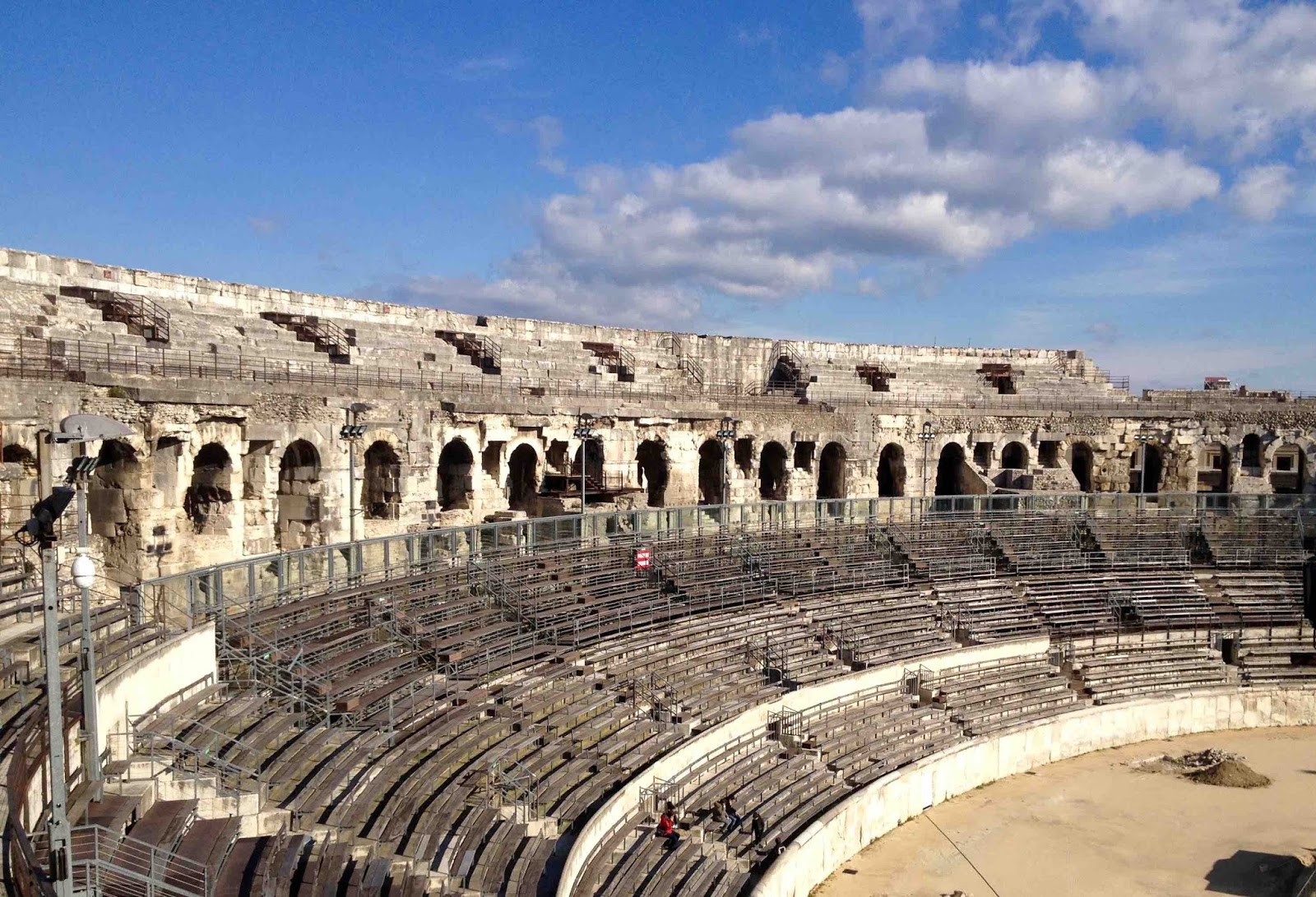
But enough about buses. I'm here to see the sites and, with just three hours (I must be back in time for the dogs' dinner and walk – I'm pet-sitting, you remember), I have it all figured out. First stop, the Roman Arena – or ampitheatre: the best preserved of its kind. And it's stunning.

Nîmes was the most important Gallo Roman town in the region – known as the Rome of France – and had a fortified wall all around it and a population of over 50,000. I plump for the 3-in-1 ticket, which gives you entry to the Arena; the Maison Carrée (which means 'square house', but in ancient Rome, a square was anything with right angled corners, so rectangular Maison Carrée sneaks in), the best preserved ancient Roman temple anywhere; and the Tour Magne, which is on Nîmes's highest point and all that's left of the old fortifications. The ticket is €12 for all three and includes an audioguide at the Arena, a film at the Maison Carrée (there's actually nothing else inside but the cinema) and entry to the Tour and is a bargain even if you only get to two of them, like I did.

As well as a good commentary, so I came away actually having learned something about gladiators and the whole business around them – for instance, they weren't slaves who had to fight to the death, but more like today's boxers, who gave themselves over to learning to fight and living the life to get fame and fortune, and didn't usually fight to the death – there's also two very small exhibit rooms: one about gladiators, with replica weapons and armour and clips from Hollywood films depicting them; and one on bullfighting, which was, to my mind, the more interesting, especially when it came to the horses the matadors ride in the ring with the bulls. This is top-level dressage in action.

Although Lonely Planet says not to bother with the film shown in the Maison Carrée, I disagree. It tells a compelling, watchable story, the computer graphics showing how the Gallo Romans built the town are impressive and I wasn't bored for a minute. Also, helpfully, there are English subtitles.

Staying in Uzès, which is hard by the Vallée de l'Eure, where the source of the water that travelled 50km by Roman-built aqueduct to Nîmes is – and which I've been to see at its source – makes it even more special watching it arrive, very prettily, in the Quais de la Fontaine. The fountain (way down at the end of my picture, but not really visible here – sorry!) marks the entrance to the Jardin de la Fontaine, which was one of the first public parks in Europe and features a beautiful statue of a water nymph, a Roman temple dedicated to Diana and the entrance to the green bit of the park where the Tour Magne is.

Unfortunately, this was where my time ran out, so I made my way back to the Gare Routière, bought a slice of French pizza – the only food in all of France that leaves a tinge of disappointment – and waited in the bright but chilly sunshine for the return bus.