Saturday, 7 February 2015

Charmouth, Dorset

Go to the beach in February? It did seem kind of crazy, especially as this is turning out to be such a cold winter, but once we were below the clifftops, the wind dropped and the variations in light were worth it on their own. 
Charmouth is fossil central on the Jurassic Coast, as it's called, and there were a fair few people out with little hammers, knocking on rocks' doors, looking for those ammonites or – wouldn't it be amazing? – something even more exciting. 
I find, when I look up at the cliffs, I start imagining that every jutting rock could be a dinosaur vertebrae, but even if you don't find anything more thrilling than a broken belemnite, of which there are plenty, it's still a wonderful environment to be in. No wonder so many folk retire down here.

The thing to do is just go small. Stop, squat down and just look at the patch of ground in front of you. Interesting rocks, bits of sea glass, bits of fossil vertebrae of something... It almost doesn't matter. It's just the going small, the focus, the being there for a minute or two examining the world.

We didn't notice at first, but the tide was going out and, as it it did, these incredible clay flats emerged, sticky to walk on but not slippery or unsafe. It wasn't long before the sand beyond them became visible and dog walkers strutted out, throwing tennis balls.

Did we find anything?!!!! No. At least, not of the physical, pick-it-up-and-put-it-in-your-pocket sort. But a bit of beauty and peace? Plenty.


Sherbourne, Dorset

Head south-west out of London and, after a bit of Buckinghamshire and a slice of Hampshire, a serving of Wiltshire and just a taste of Somerset, you (finally!) get to Dorset, to my mind, one of England's nicest counties. Slightly wonky hills; beautiful, wild beaches; thick, high hedgerows lining the roads; and plenty of pretty towns, history and opportunities to go fossiling.

We've come down for a long weekend, staying in very sweet, thatch-roofed Mouse Cottage, courtesy of West Country Cottages. But, to break up the approx 3hr journey from town, we stopped in Sherbourne, also in Dorset, as it calls itself 'one of the prettiest towns in England'. Let's see, I said to companion...

Inside The George
I have to add here that, being that it's the first weekend of February when we visit, it's bitingly cold. The sun does something to take the teeth out of the wind, but not enough to make us want to spend too long outdoors, so it's going to be a quickie.

Cheap Street
We park in the pay-and-display car park, helpfully signposted as we entered town. It's conveniently just behind the high street, which is called, delightfully, Cheap Street. Our goal? Find a pub still serving lunch, as it's nearly 3pm. At the top of Cheap Street, we find two: The White Hart, which looks like it can't decide if it's open or not, even though the sign outside says it is, and, almost opposite, The George, which turns out to be the oldest pub in town.

This is the one we choose and yes, the waitress says, glancing at the clock, they're still serving. We quickly grab a table, get told the specials (variations on pork roast, lamb roast, beef roast and chilli with rice) and glance at the menu, which lists exactly what you'd expect from a pub: baked potatoes with various toppings; cod and chips, scampi and chips, and a ploughman's lunch (translated means: some form of bread, often a baquette, with Cheddar cheese, chutney pickle and sometimes a bit of salad on the side).


After lunch, we brave the cold with a brisk stomp down Cheap Street, which is, as promised very pretty, though the most arresting thing I see is a life-size statue of a bear on an upper terrace.

At the far end of the street is the Abbey (flying buttresses, very pretty, c-c-c-can we get back in the car now?), and then a quick trot back up the street, through the archway into the alley and round to the car park again.

The Abbey
Sorry, Sherbourne, I'm sure you deserve more time, but it will have to be on a warmer day.


Friday, 23 January 2015

Alhambra in January

It was about 60°F (that's 15°C for you Europeans!) in full sun down in Nerja, east along the coast about an hour's drive from Malaga, but up in Granada, you could shave another 15°F off that (so 7°-ish C) in the shade, making me wish I'd brought gloves and a hat for our jaunt. Happily, as the day wore on, the sun bore down ever brighter, warming things up.

What's astonishing if you're seeing it for the first time, is the juxtaposition of palm trees against a backdrop of snow-covered mountains, which alone makes a trip to the Alhambra at this time of year worth it. But there's another bonus: you mostly have it to yourself. Not entirely, but as close as you can probably get. So, tip 1: dress up warm, pick a sunny day and go in the middle of winter.

Among the delights of this 13th-century fortress-cum-palace-cum-extensive gardens is how you can wander about. I couldn't help thinking that, in another 10 or 15 years, they'll have laid down plank-covered walkways and you won't be able to just tramp over the ancient tiles. But, for now, what a delight to walk in the footsteps of all those who went before.

Granada seen from the Alhambra
Tip 2: Pre-book your ticket to visit the Nasrid Palace. It costs about €15 and you have to choose one of the half-hour entry slots (ie, 11am, 11.30am, etc). Once in, you can stay as long as you like, but you need to be in the line about 10 minutes beforehand.


We booked a 12.30 entry and arrived at the Alhambra at about 11am. I think we could have got there a half hour earlier or booked a slightly later entry, as the way it's laid out, you can see almost everything else before you go in to the Palace and, afterwards, head up to the Generalife gardens and building, which then feed you back to the car park. We tried to see most of the place, including some of the woods down below (though we skipped the art museum) and were in the grounds a total of about 6 hours.

One other thing to know about that ticket for the Palace: hang on to it! It will get you into Alcazaba, the old fortress, and the building in the Generalife gardens.

Alcazaba Fortress
Tip 3: The audio guide (€6.50) was almost useless (sorry, Alhambra!) and became something of a little joke between my companion and I. Mostly, it described what we could see when we arrived at each room or destination. I think, if you really want to go deep with the place, booking a human guide would be the way to go. Alternatively, the free map has an overview and timeline.

Lion fountain
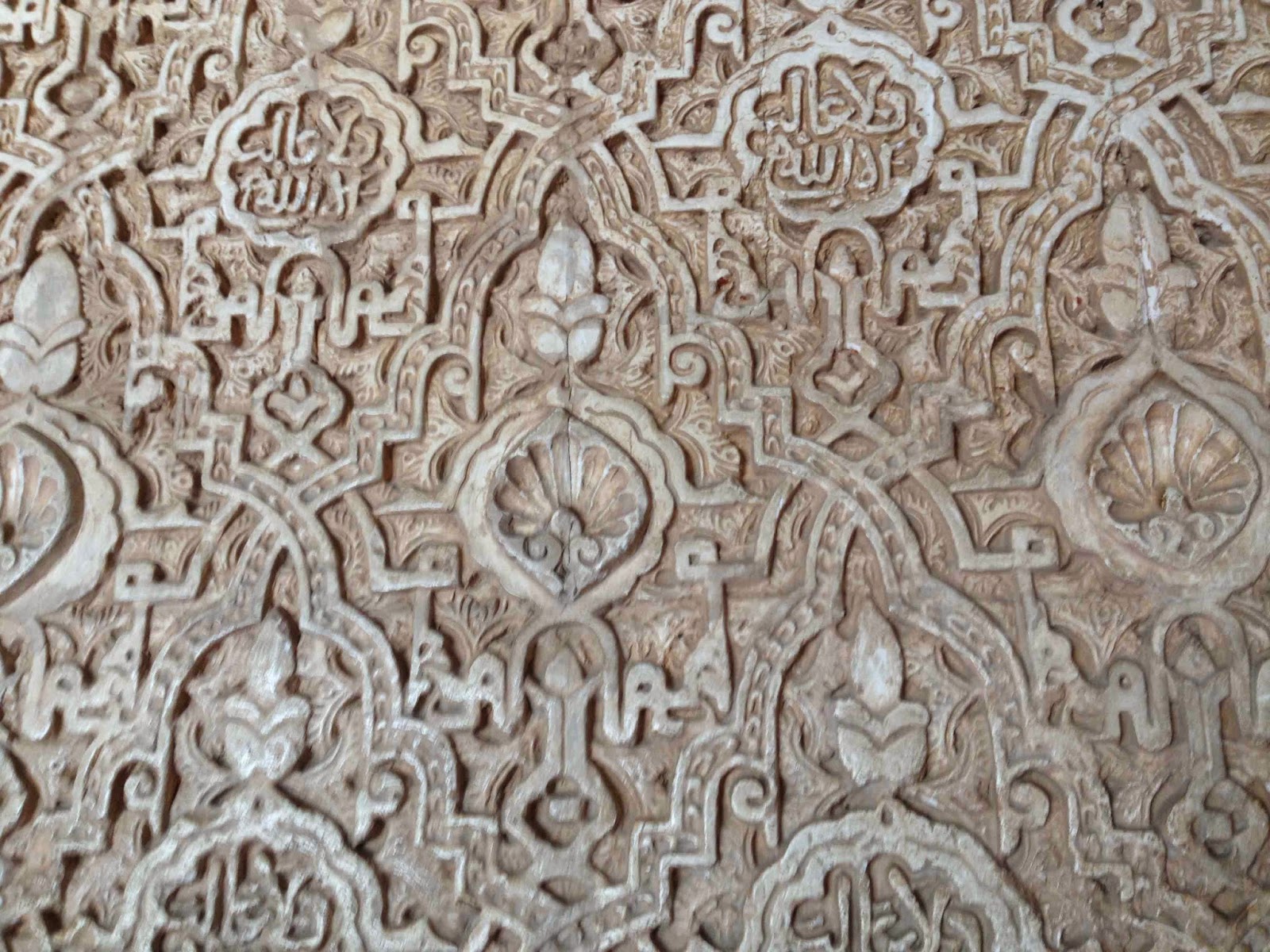
We loved the old Moorish filagree windows and plasterwork, but best of all was the lion fountain. There was something so pure and simple about all that white marble against the intricate pillars and ceilings all around that was soothing and simply beautiful.

And the Generalife gardens, which contained various elements considered essential for a pleasing outdoor space – that is, water, spaces divided into equal parts and long walkways – provide plenty of picnic-spot possibilities, or just nice spaces to walk through and enjoy the views.

One final tip: driving in Spain is very straightforward, the roads aren't crowded, signs are clear – in fact, the ones for the Alhambra are in red, making it very easy to find from the highway (motorway, autobahn, whatever you call it!) – and our car rental, from Autos Tivoli in Nerja, cost us €45 for the day, plus about €10 in gas (petrol), so between two, it felt like the most comfortable way to travel, as we could suit ourselves. However, there are buses as well.


Thursday, 1 January 2015

Good-bye 2014 and hello 2015!

Nerja
What a year! Plenty of the good stuff, including travels near and far, good times with friends old and new, and the positive progression of life, so I will look back fondly on this one. I do know it has been unbearably tragic for some, and I am thinking now of those whose travels ended in terrifying ways and the people who loved them; those who are caught up in seemingly endless conflict; whose lives are turned inside-out by the cruelty of pestilence and more everyday illness and diseases, which are no less devastating. So to them I say, may 2015 be kinder to you and may we all find ways to live beyond the sadness, be strong and live happy.

Not to be all preachy, but I think we may as well enjoy the beauty and opportunities to hold happiness close when we can, because none of us knows when it may be snatched away. And, on that note, it must be time to move on to tales of... Andalucia! Viva España!

Christmas tapas lunch on the terrace
This year's Christmas week was spent in what must be the town of Nerja's most charming house. Apologies for sounding so smug. It looks like the least imposing place on its pedestrianised street: just a door most folks would have to duck a little to get through, a single window above it, the façade as simple and plain as can be. But go inside and it widens out from the point of its front like a triangle, and has three terraces, five bedrooms and – best of all – a garden with fruit trees that runs straight to the sea.

I don't want to give its location away entirely, so will just add that it has strong family connections to Spanish poet and writer Federico Garcia Lorca.

Of course, we all know that much of the southern coast of Spain has seen overdevelopment in the form of not-so-charming holiday home development, but there is still plenty of beauty here and it's worth remembering that there's usually a reason an area becomes a popular holiday destination (ie, year-round warm sunshine, natural beauty, good food, pleasant ambience [can you tell I'm refraining from saying 'friendly, smiling locals'? But there is a general sense that visitors are a welcome addition rather than a curse]).
Frigiliana

One of the jolly things to do here is using the cheap and reliable public buses: €1.17 will take you, for instance, to Frigiliana, an archetypal, but no worse for that, white-washed hill town about a 20-minute ride inland. It has a fascinating history as well, filled with trouble and strife, the story told in painted tiles on walls as you walk up. Up being the operative word and, when you get reasonably high, look out for a tapas place offering terrace views.

If you pick up a map from the tourist office, you can follow the trail right out the top of town and up to where there was once a fort. There's no sign of it now – just three more-recent balustrades at strategic points to look out from – but you get the satisfaction of tremendous views, both to the sea and to the Sierra Tejeda, Almijara and Almara Natural Park inland –  and having somehow achieved something.


One small word of warning: there is a notice painted on walls at two stages, one just before the final ascent and another at the top, which shouldn't be ignored. They tell you that the donkeys which graze up here can bite. I don't know about that, but I do know they can charge and, also, quite aggressively try to kick you, so do not be taken in by their seemingly friendly manner if they start to approach. They are definitely not coming to say hello!


Sunday, 7 December 2014

Wells-next-the-Sea, Norfolk

 There are set things one does when visiting Wells, starting with a wander up Staithe Street. Staithe, by the way, means 'place where you load or unload ships', so no prizes for guessing that this narrow, almost alleylike road leads from the harbour.

Along the way, there are plenty of gift shops and women's upmarket clothing stores, but my favs are the workaday ones, like the butcher (who also sells beautiful rare-breeds sheepskins) and the grocery, with his pretty vegetables and, at this time of year, holly, out on display.

If you've been to Wells in years gone by, you'll remember there was a great hump of sand down on the beach. But, after last year's huge storms and floods, that hump has been much reduced and in fact, where once it was a dromedary, it is now a low-lying bactrian camel.

After the customary beach inspection (with the not unrealistic hope of seeing seals), we carried on walking right down to the northern end of the beach to a lonelier, but equally pretty spot, before turning in and making our way back through the pines to town.

The other must-do at this time of year is to be there for the switching on of the Christmas lights. "Watching someone turn on some lights? That's supposed to be fun?" Ah, you haven't seen them then. The great event took place in front of Howell's Delicatessen - worth visiting at any time for its selection of local produce – but on this evening they were selling pulled pork sandwiches and hot hard cider, and giving away sweet mince in filo-pastry twists. A local celeb from a regional BBC program did the honours, going up in a fork-lift type thing and making just the right level of jokes ("Come on folks, make it worth my while – it took me an hour and a half to get here. I was only 5 miles away, but you know what the roads round here are like!") and getting a good roar from the crowd at the appropriate moments. There was, suddenly, a community feel, even for those of us not from this community, and I saw what all the fuss was about.

In case you're tempted by the quaintness of it all – and who wouldn't be? – it's worth knowing that nothing comes cheap: even the beach huts start at £55,000... Still, we can all dream!

Another local must-do is Holkham Hall estate – a vast tract of land, grand Palladian house and even a village where the estate workers live – though some of these buildings have been turned into gift shops and a hotel and pub – still owned by the original Coke family, who established it back in the 1600s.

We took the local bus to Burnham Overy and walked along the estuary here out to the sea.

There is something quite raw and primordial about this landscape that defies the centuries of human occupation. I think it is this, plus the wide open skies and emptiness that make it both so soothing and beautiful. This is a wonderful place to escape the crowds that seem to fill most of the world nowadays.


So, a lovely walk along the windy beach and then back to The Victoria Inn, one of the Holkham estate buildings that is now a hotel and pub/restaurant. Fortunately, they were serving mulled wine and a hearty soup, exactly what's wanted after a bracing stomp along the coast.


There were some nice touches too, like a fabulous painting of an ostrich (a family emblem) outside the loos and, inside them, wallpaper with a repeating pattern of an ostrich with its head in the sand.


I'm including a gratuitous shot of the sunset at Holkham just because it's so pretty.

Finally, if you're visiting the north Norfolk coast between November and the end of January, you'll want to take a seal-watching boat trip from Morston quay to Blakeney Point. There are two outfits who run these. We went with Temples, but there is also Beans Boats. Our guide on the boat knew all about the grey seals that come to breed here for these three months, was happy to answer any questions and, for those of you lucky enough to have a pooch, dogs were more than welcome. In fact, there were even three boat dogs, who came around to the guests and gave everyone a happy sniff and tail wag.

The entire trip takes about an hour and the top tip is: dress WARM. It is really cold out on the water, even if you get a sunny day. So, hat, gloves, windbreaking coat, thermals and a blanket will mean you enjoy it all much more.

I don't need to tell you how cute baby seals are, but it is pretty special to see them nursing and some of the pups we saw had literally only just been born.

Within the estuary the water is very calm, but obviously, once you get round the point, it's a bit wilder and the waves pick up. Our boat went for just a quick look, so that we could see the seals all along the water's edge - quite a sight. Though there are plenty of them within the estuary too.

Afterwards, there's only really one thing to do: get yourself to the nearest pub – in this case, the Anchor Inn – and warm up over a glass of red and something off the gastro menu.